2025 Annual Report
Imagining Better Access to Early Childhood Support in New York
Early learning experiences and developmental milestones can have a lifelong impact. When a child is born into a family facing poverty, those formative years can become even more complicated.
The Health Foundation is proud to partner with nonprofit organizations working on behalf of our youngest children, including Early Childhood Alliance (ECA) Onondaga and Integrated Community Planning (ICP) of Oswego County. Both nonprofits have implemented a dynamic model for children and family support in their counties. We’re also proud to support Liftoff WNY, an advocacy collaborative fighting for expanded child care and increased investment in early childhood development.

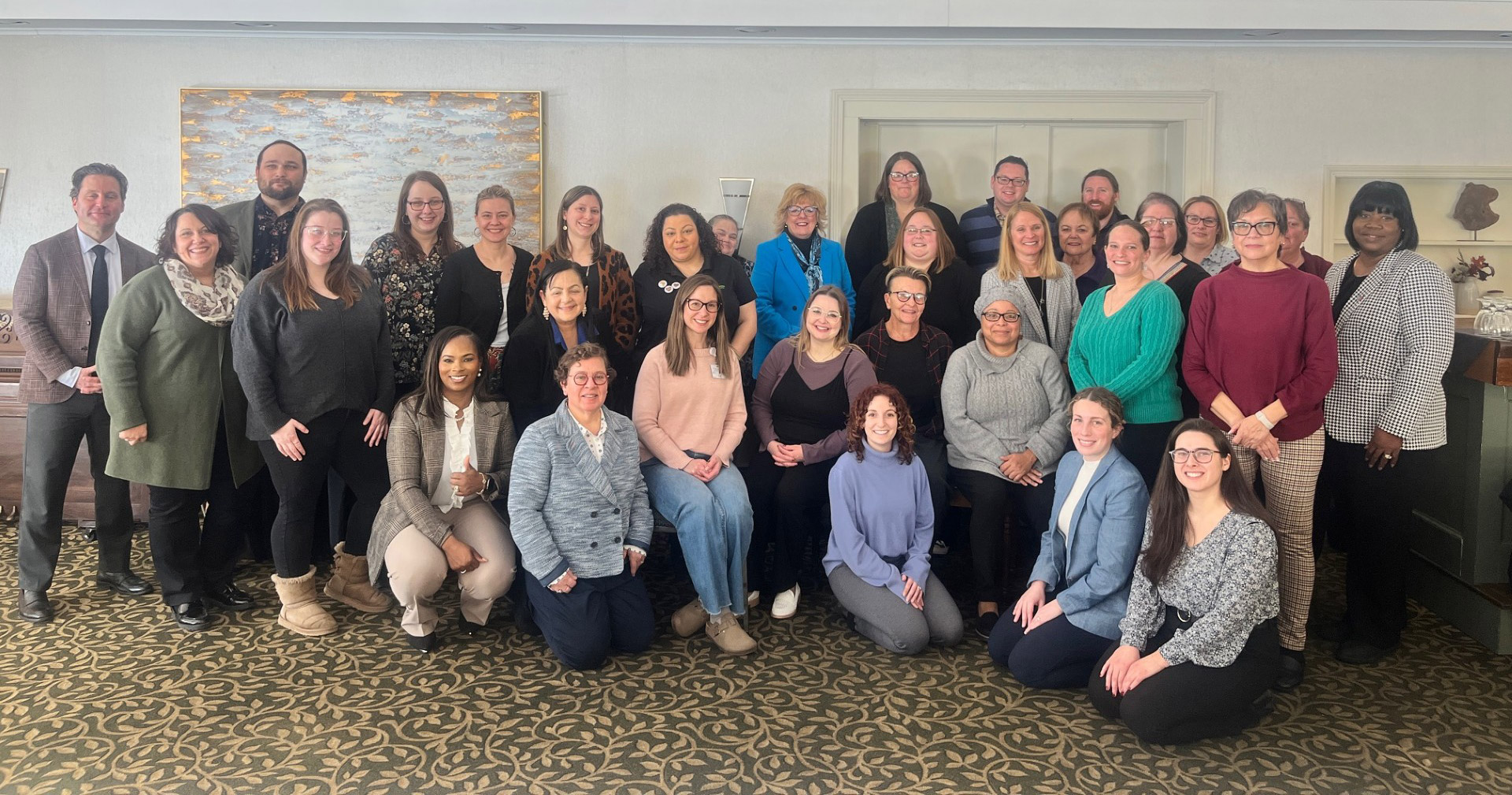
Western New York advocates and Onboard members in Albany for Kids Can’t Wait Advocacy Day
Making Valuable Connections
Connecting families on low incomes with community partners and resources is part of Help Me Grow, a community-driven model adopted throughout the country to promote early childhood development and confident parenting. In New York State, there are currently six Help Me Grow hubs, including Onondaga County and Oswego County. The Early Childhood Alliance (ECA) Onondaga has been using the model since 2019, and Integrated Community Planning (ICP) of Oswego County adopted it in 2023.
“Our goal is to connect existing programs, providers, families, and the community so that we can strengthen that support system and expand our reach for the zero to five population.”
Brandy Koproski, Executive Director, ICP of Oswego County
By using a centralized call center, parents can be helped by a family resource specialist who will refer them to a wide range of services, including a diaper bank, an infant formula bank, daycare, pre-K programs, pediatric care, family therapy, early intervention, and more.
At the heart of the model is an emphasis on trust-based relationships with community partners and the families they serve. “We invite parents and caregivers—the target population we’re trying to support and serve—to co-create solutions with us. If they’re not at the table co-creating strategies for improving the system with us, then we’re missing a piece,” says Bethany Creaser, Executive Director of ECA Onondaga.
Onondaga County is home to Syracuse, a midsize city that includes Syracuse University, while Oswego County is primarily rural. When Oswego adopted the Help Me Grow model in 2023, it had only 12 resources in the 211 CNY resource directory. If families needed a pediatric dentist, for instance, they would be referred to a practice in Onondaga County. The Oswego Help Me Grow team would provide transportation services. Resources in both counties have grown since then, and the data collected is used not only to make connections, but also to keep in touch with families who don’t follow through on the referrals. The goal is to offer support and remind them of the free services that are out there.
Good data can make a great difference
The Help Me Grow model includes early childhood screenings that provide insights into a child’s learning and development. These screenings are what first inspired the Health Foundation to partner with Help Me Grow hubs in western and central New York. The Ages & Stages Questionnaire (ASQ) focuses on five domains of development: communication skills, fine motor skills, gross motor skills, social-emotional skills, and problem-solving skills. A lag in one or two domains might cause anxious parents to think their child has a problem or they’re doing something wrong. That’s one reason why the ASQ is referred to as a questionnaire, not a screening. After a family completes it, a Help Me Grow family resource specialist follows up and provides tip sheets for any areas of concern.
The Onondaga and Oswego teams also use data strategically to get a sense of the community-wide landscape. In 2024, ECA Onondaga was one of five organizations nationwide selected to participate in RAPID’s 2024 Community Voices Cohort. Since then, the coalition has completed three community surveys. Questions like How are you doing? Where are you struggling as a parent? Are you aware of the free resources in your community? elevate the voices of parents and family caregivers, allowing the Help Me Grow teams to identify any resource gaps in the community.

Taylor Peterson, ICP’s Help Me Grow Coordinator, leads an activity at a school STEM event in Oswego County.
Strong partnerships for better outcomes
Brandy and Bethany have strengthened partnerships with local nonprofits and several health care providers. Through a program called Pediatrics Supporting Parents (PSP), Help Me Grow Onondaga has teamed up with the Upstate Pediatric and Adolescent Center. Bethany explains that first-year pediatric residents do a rotation with the Help Me Grow team right in the ECA Onondaga office and learn about the available resources and services. Opportunities like this only fuel the two directors’ excitement about future collaborations with providers and pediatricians.
“Being able to understand the data, understand the lived experience of those parents and providers and others in the community who deeply care about children, and then organize and elevate the issues takes time and patience.”
Rachel Bonsignore, Executive Director, Liftoff WNY
Winning Hearts, Minds, and Dollars Through Focused Advocacy
If Help Me Grow is a bottom-up model for better community-wide coordination and collaboration, then Liftoff WNY is the perfect counterpart: a top-down collaborative focused on advocacy and coalition building. Founded in 2018, Liftoff works to improve the lives of 100,000 young children residing in the eight counties of western New York, while collaborating with multisector partners across the state to create systems-level change. It has an aligned-action network of more than 30 funders and cross-sector leaders in western New York and regularly holds stakeholder convenings. It’s also the state’s only early childhood funders collaborative.
Since becoming Liftoff’s inaugural Executive Director in 2019, Rachel has championed a bold, policy-driven agenda through strategic partnerships, relentless advocacy, and a volunteer training and mobilization program called Onboard. Managed by Advocacy and Learning Coordinator Megan Battista, Onboard has trained more than 80 community leaders and groups, parents, and other stakeholders. The program capitalizes on the enthusiasm of people who simply want to make a difference.
Statewide advocacy wins
- 11% increase in funding for preschool special education and New York State-approved 4410 schools in 2023
- 5% across-the-board rate increase for New York State’s Early Intervention Program
- $1 million in annual funding for Help Me Grow
- 80+ volunteers trained and mobilized for advocacy
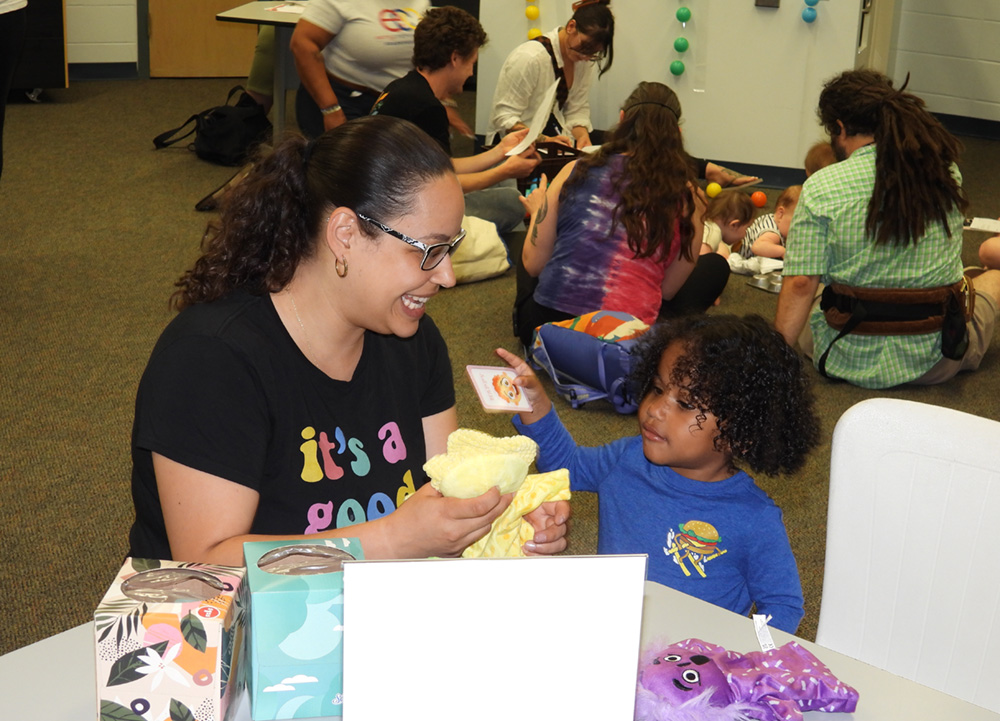
A mother supports her child’s social-emotional development by engaging together in a hands-on activity at a Help Me Grow Onondaga Books, Balls & Blocks event.

A grandfather takes an active role in his grandson’s development by completing a developmental questionnaire at a Help Me Grow Onondaga Books, Balls and Blocks event.
Universal screenings and early intervention
When Liftoff first launched, a core priority was universal screenings for early childhood development. Partnering with the regional Help Me Grow hubs, Liftoff leveraged insights from the Ages & Stages Questionnaire and other data. Being able to pinpoint gaps in community resources helped the team secure $1 million in annual state funding for Help Me Grow.
Preschool and pre-K are well-known concepts for the general public. Less familiar is early intervention—services focused on young children who have, or are at risk of having, a developmental delay, a disability, or a health condition that could affect their development and learning. When a person is born with a developmental delay, it costs more to care for them as a young adult with learning challenges than it does to provide therapy during the preschool years. Rachel says there are more than 70,000 children enrolled in New York State’s Early Intervention Program, which is why it remains a top priority for Liftoff’s advocacy agenda.
She shares the story of one state senator’s change of heart. He easily understood the economic argument for child care. Working parents need a place to bring their kids, and child care providers and preschools are like any other businesses that employ workers in the community. But he couldn’t grasp the need for early intervention services—wouldn’t a child with a developmental delay simply grow out of it? During a visit to Albany, western New Yorkers from the Onboard network met with the legislator. The Liftoff group included a therapist who owned an early intervention business. She wondered why, despite providing countless hours of care for children, her reimbursement rates hadn’t seen an increase in three decades. The therapist shared her perspective as both a small-business owner and a health provider helping families in the district—and immediately won the senator over. Shortly after the meeting, the senator’s staff reached out to Rachel to say he was throwing his support behind Liftoff’s agenda.
Looking forward
Rachel and her team are energized by recent legislative outcomes and the prospect of more victories in Albany. She cites the passion of the Onboard volunteer network, the dedication of organizations close to the ground, and the power of collaboration. All of this puts into sharp focus a bold vision for a new early childhood landscape in the country’s fourth most populous state. “Rather than giving someone a fish or even teaching someone how to fish, we’re revolutionizing the fishing industry,” Rachel says with a smile.